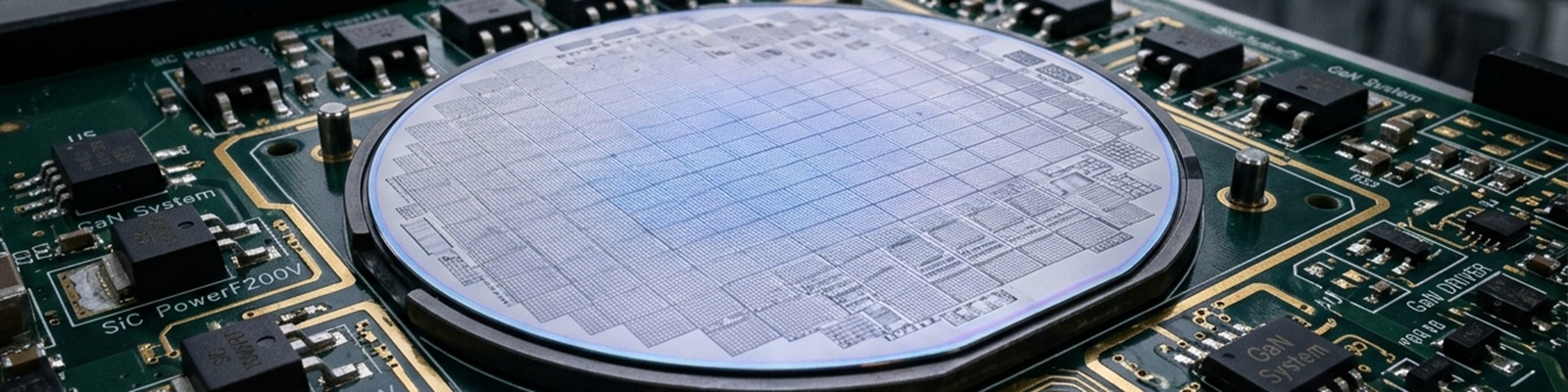
SiC semiconductors are transforming power electronics by delivering superior efficiency, higher voltage handling, and better thermal performance than traditional silicon. These wide-bandgap materials – silicon carbide (SiC) and gallium nitride (GaN) – enable smaller, lighter, and more energy-efficient systems for electric vehicles (EVs), renewable energy, data centres, and industrial applications. At Panasia Solutions, we help clients integrate these advanced materials into real-world products through our end-to-end design and manufacturing expertise.
If you’re wondering why SiC semiconductors matter right now, the answer is simple: they cut energy losses dramatically while supporting the global push toward electrification and sustainability. In the first 1-2 paragraphs, you’ve already seen the core value – higher efficiency and power density that silicon simply can’t match. This post dives deep into how SiC and GaN work, their advantages, real-world uses, market trends, and how a proven manufacturing partner like Panasia Solutions makes adoption seamless.
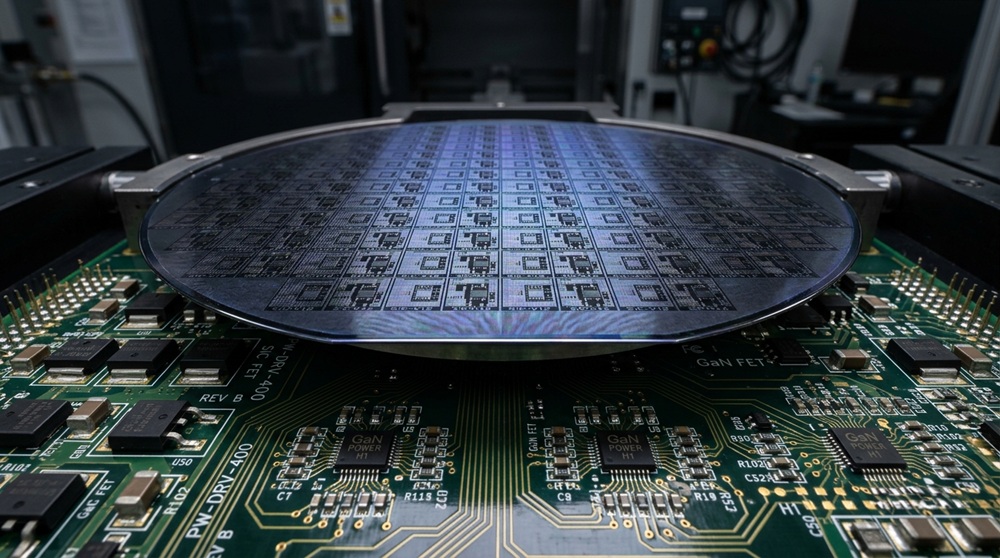
Understanding SiC and GaN: The Wide-Bandgap Revolution
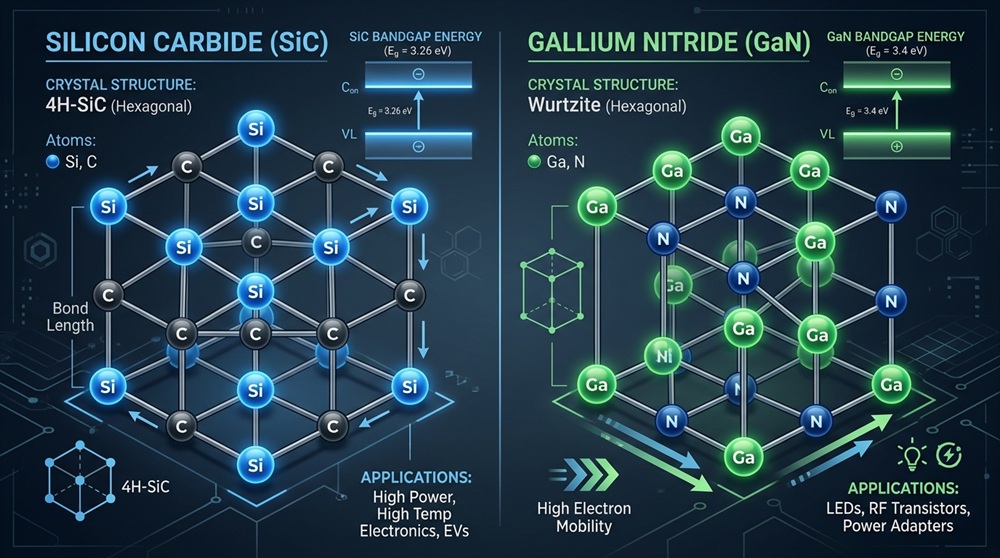
Traditional silicon power devices have served us well for decades, but they’re hitting physical limits in today’s high-power, high-efficiency world. Enter SiC semiconductors and GaN – wide-bandgap (WBG) materials with bandgaps roughly three times wider than silicon (about 3.26 eV for SiC and 3.4 eV for GaN versus 1.12 eV for Si). This wider bandgap allows them to withstand much higher electric fields, operate at higher temperatures, and switch faster with far lower losses.
SiC, or silicon carbide, is a crystalline semiconductor formed by combining silicon and carbon. It excels in high-voltage and high-power scenarios. GaN, gallium nitride, is typically grown on silicon or other substrates and shines in high-frequency, compact designs. Both outperform silicon in critical metrics like breakdown voltage, thermal conductivity, and electron mobility.
Key material properties at a glance:
- SiC: High thermal conductivity (3.7 W/cm·K), breakdown field ~10x silicon, ideal for 650V–1700V+ applications.
- GaN: Extremely fast switching (zero reverse-recovery charge in many designs), lower gate charge, enabling MHz-level frequencies.
- Silicon baseline: Limited to ~600V in many power apps, higher losses, bigger cooling needs.
These differences make SiC and GaN complementary rather than direct competitors in most cases.
Why SiC Semiconductors Outperform Silicon in Power Electronics
SiC semiconductors isn’t just buzz – it’s the technology driving real gains. SiC devices (MOSFETs, diodes, modules) reduce conduction and switching losses by up to 70-90% compared to silicon IGBTs or MOSFETs. That translates directly to:
- Smaller heat sinks and passive components: higher power density.
- Higher operating temperatures (up to 200°C junction): less or no derating in harsh environments.
- Overall system efficiency gains of 2-5% or more, which compounds in EVs (longer range) or solar inverters (more energy harvested).
Industry leaders are scaling 200mm SiC wafers and next-gen trench MOSFETs, driving costs down while performance climbs.
GaN: The High-Frequency Powerhouse for Compact Designs
While SiC semiconductors dominate high-voltage territory, GaN FETs and HEMTs rule where speed and size matter most. GaN offers:
- Switching frequencies 10x higher than silicon (and often higher than SiC).
- No body diode reverse-recovery losses in many topologies.
- Superior power density for 100-650V applications.
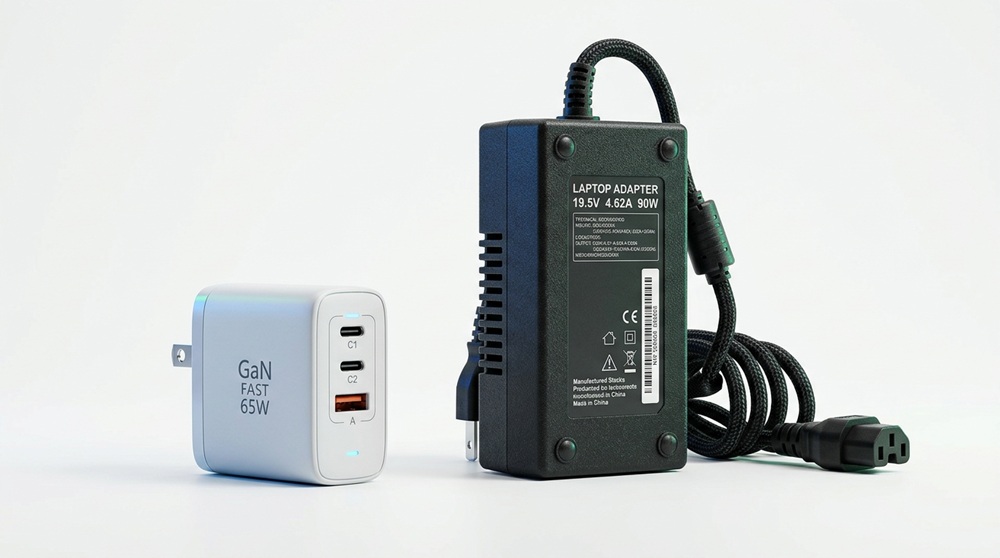
Typical uses include consumer fast chargers (think 65W+ USB-C in tiny form factors), data-centre power supplies, telecom base stations, and EV onboard chargers/DC-DC converters. GaN enables designs that are lighter, cooler, and cheaper to manufacture at scale for medium-power needs.
SiC vs GaN: A Practical Comparison for Engineers and Decision-Makers
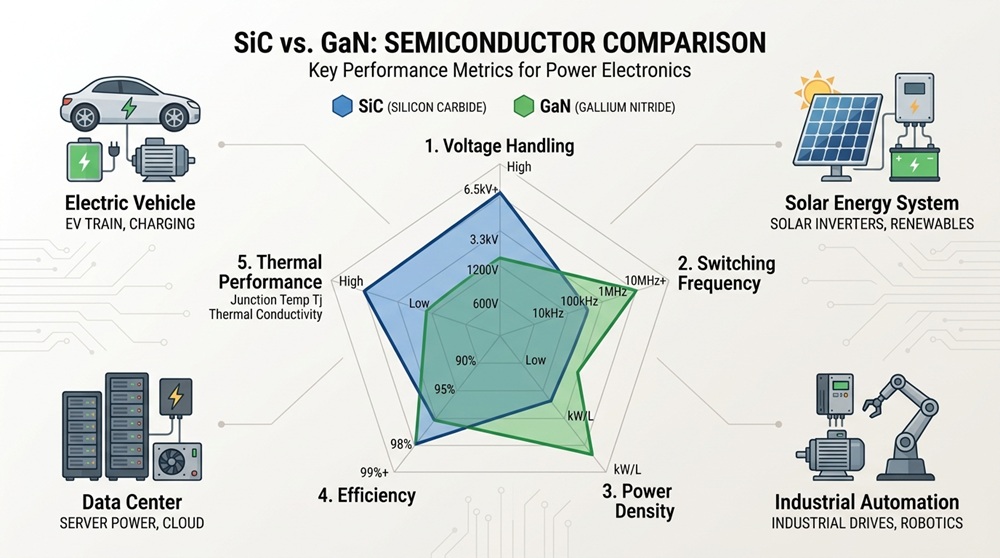
Choosing between SiC semiconductors and GaN depends on your voltage, power, frequency, and size targets. Here’s a clear breakdown:
Aspect | SiC Semiconductors | GaN Materials | Best For |
Voltage Range | 650V–1700V+ (high-power) | Up to ~650V (medium-power) | SiC: EV inverters, grids |
Switching Frequency | High (hundreds of kHz) | Very high (MHz range) | GaN: Chargers, data centers |
Power Density | Excellent for high power | Superior for compact systems | GaN: Consumer/compact; SiC: Scale |
Thermal Performance | Outstanding (high temp tolerance) | Good, but lower than SiC | SiC: Industrial, automotive |
System Efficiency | 98%+ in high-power apps | 99%+ in high-freq apps | Both beat silicon dramatically |
Cost Trajectory | Falling rapidly with scale | Competitive in volume | Application-specific |
In practice, many systems combine both – e.g., SiC in the main inverter and GaN in auxiliary converters, as detailed in technical comparisons from leading semiconductor manufacturers like Texas Instruments.
Real-World Applications Transforming Industries
- Electric Vehicles (EVs): SiC semiconductors are now standard in 800V architectures for traction inverters, onboard chargers, and DC-DC converters. They extend range by 5-10%, enable faster charging, and reduce vehicle weight. GaN handles auxiliary power efficiently.
- Renewable Energy & Smart Grids: Solar inverters and wind converters using SiC achieve higher yields with less cooling. Bidirectional power flow in microgrids benefits from SiC’s robustness.
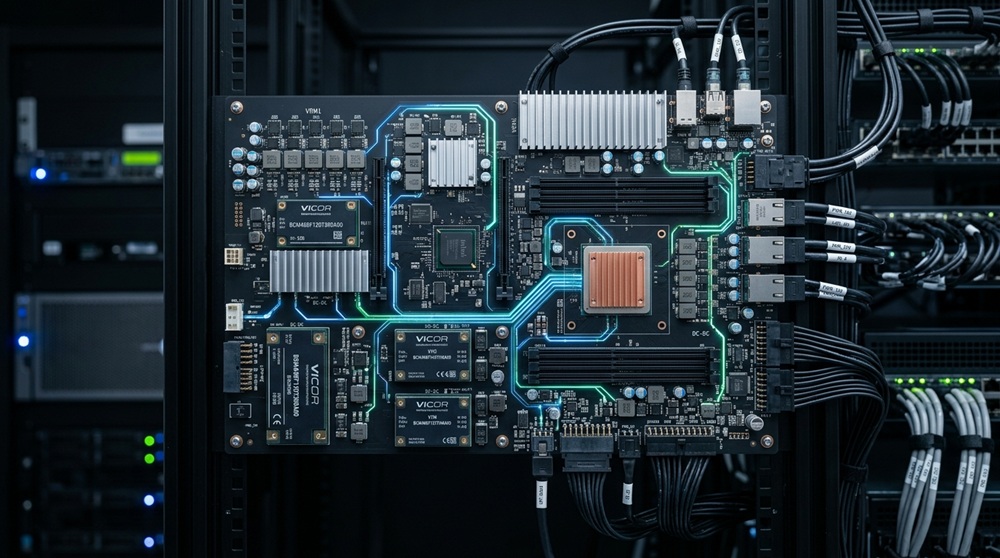
- Data Centers & AI Infrastructure: GaN power supplies slash energy use and rack space – critical as AI drives explosive demand. SiC supports high-voltage distribution.
- Industrial Motor Drives & Power Supplies: Both materials cut losses in variable frequency drives, UPS systems, and factory automation.
- Consumer Electronics: GaN chargers dominate premium fast-charging markets.
Industry Insights and Market Data: Explosive Growth Ahead
The SiC semiconductors market is booming. According to recent analysis from Precedence Research, the global silicon carbide semiconductor devices market is expected to grow from USD 3.64 billion in 2025 to USD 4.51 billion in 2026, reaching approximately USD 24.95 billion by 2034 at a CAGR of 23.83%. Automotive (EVs) remains the largest segment, while energy & power shows strong growth due to renewables and grid modernization.
Another leading forecast from MarketsandMarkets projects the broader SiC market from USD 3.83 billion in 2025 to USD 12.03 billion by 2030 at a 25.7% CAGR, driven by EVs, renewables, and industrial electrification.
For GaN, the power device market is growing rapidly in targeted segments. Yole Group’s Power GaN 2025 report forecasts the power GaN device market expanding at a 42% CAGR to reach about $3 billion by 2030, fuelled by consumer chargers, data centres, and emerging automotive adoption.
Asia-Pacific leads SiC adoption thanks to EV manufacturing hubs – perfectly aligned with Panasia Solutions’ Shenzhen headquarters and global supply chain expertise.
Challenges in Adopting SiC and GaN - and How to Overcome Them
Higher upfront material and processing costs, supply-chain scaling (though improving with 200mm wafers), and the need for specialized design know-how are common hurdles. Gate-driver compatibility, packaging for high-frequency parasitics, and qualification for automotive-grade reliability also require expertise.
This is where experienced manufacturing partners shine. Panasia Solutions’ 25+ years in design, engineering, prototyping, and OEM/ODM production for high-tech electronics means we handle these complexities end-to-end – IP protection, ISO-compliant processes, and global logistics included – so your team focuses on innovation, not manufacturing headaches.
Why Panasia Solutions Is Your Trusted Partner for SiC and GaN Power Electronics
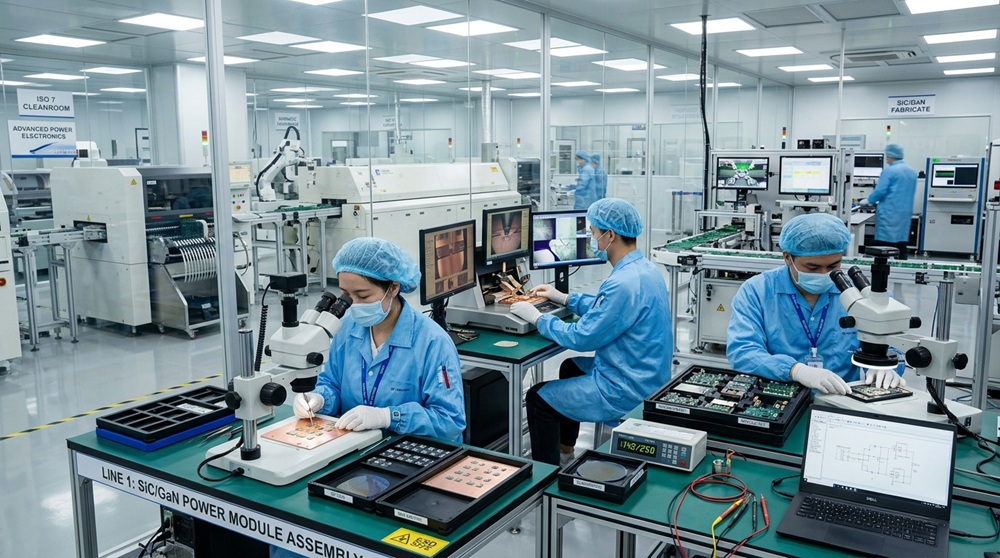
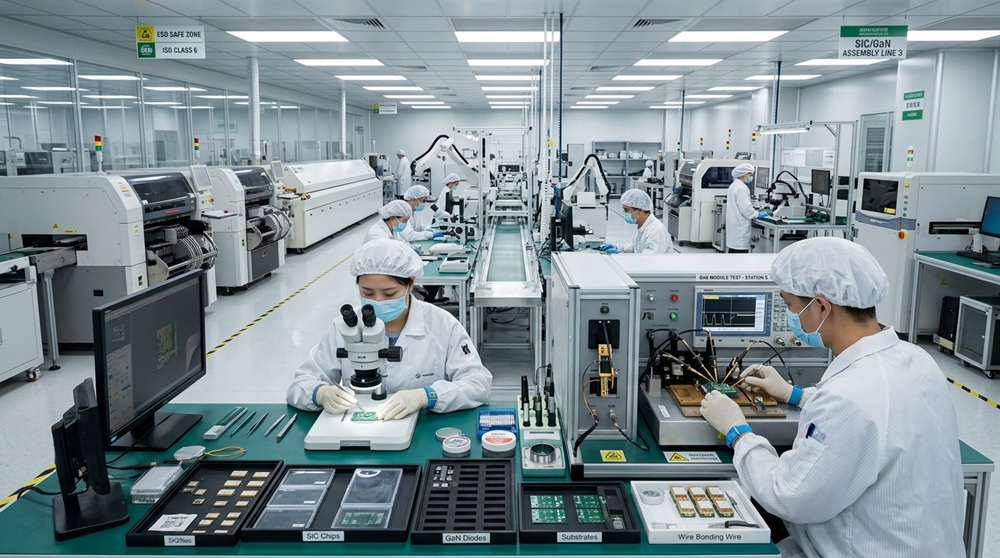
With over 25 years of experience turning concepts into market-ready products, Panasia Solutions delivers black-box manufacturing, supply-chain management, and full-system integration for advanced power electronics. Whether you need custom SiC inverter modules, GaN-based chargers, or hybrid solutions, our end-to-end process ensures quality, speed to market, and cost efficiency at scale.
We don’t just assemble – we engineer thermal solutions, optimize layouts for high-frequency performance, and qualify products for the most demanding applications. Clients worldwide rely on us for reliable, high-volume production of next-gen power systems.
The Future of Power Electronics Is Wide-Bandgap
SiC semiconductors and GaN are no longer emerging – they’re the new standard enabling a more efficient, electrified world. From EVs hitting longer ranges to data centres slashing power bills and solar farms maximizing green energy output, these materials deliver measurable ROI today.
Ready to harness SiC and GaN for your next power electronics project? Browse our capabilities or contact our expert team for a free consultation. Let’s build the efficient, high-performance systems of tomorrow – together.